
|
|
ASEME |
|
Product Integration and Functional Testing |
Product Integration Services |
||
| ✓ | Building a Product Integration Stand | ASEME Can facilitate the stand design, procurement and build to ensure powerfull testing capabilities, root cause analysis and 2nd line support for field issues |
| ✓ | The Testing Chain, what is most effective | ASEME can facilitate a cost effective test map, from component and software testing, through integration to functional, and FAT, SAT testing |
| ✓ | Aggressive Turn-Around, for Ultra Competitive Time to Market | ASEME can facilitate Turn-Around time review and pain-point removal, for iterative design - test loop |
For ASEME, product integration and functional testing is key to unlock powerfull quality, early testing, root cause analysis and effective 2nd line support.
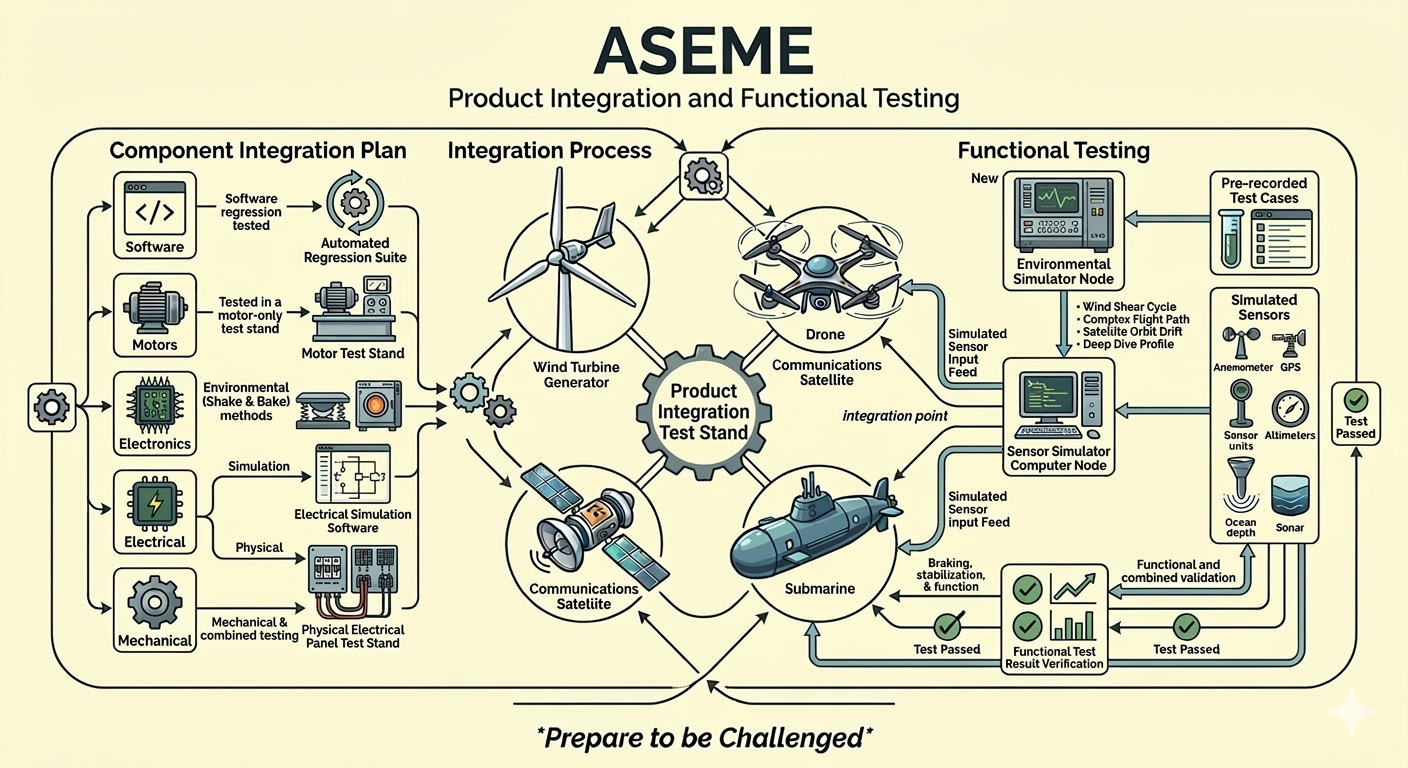
To avoid customers discovering quality problems it is key to have an integration test rig. On the test rig, it should be possible to re-create any field conditions or user influences made on the product. This will improve your turn-around from fault found to fix tested, which will also radically shorten your time-to-market, but also impress customers with the response time on product feedback.
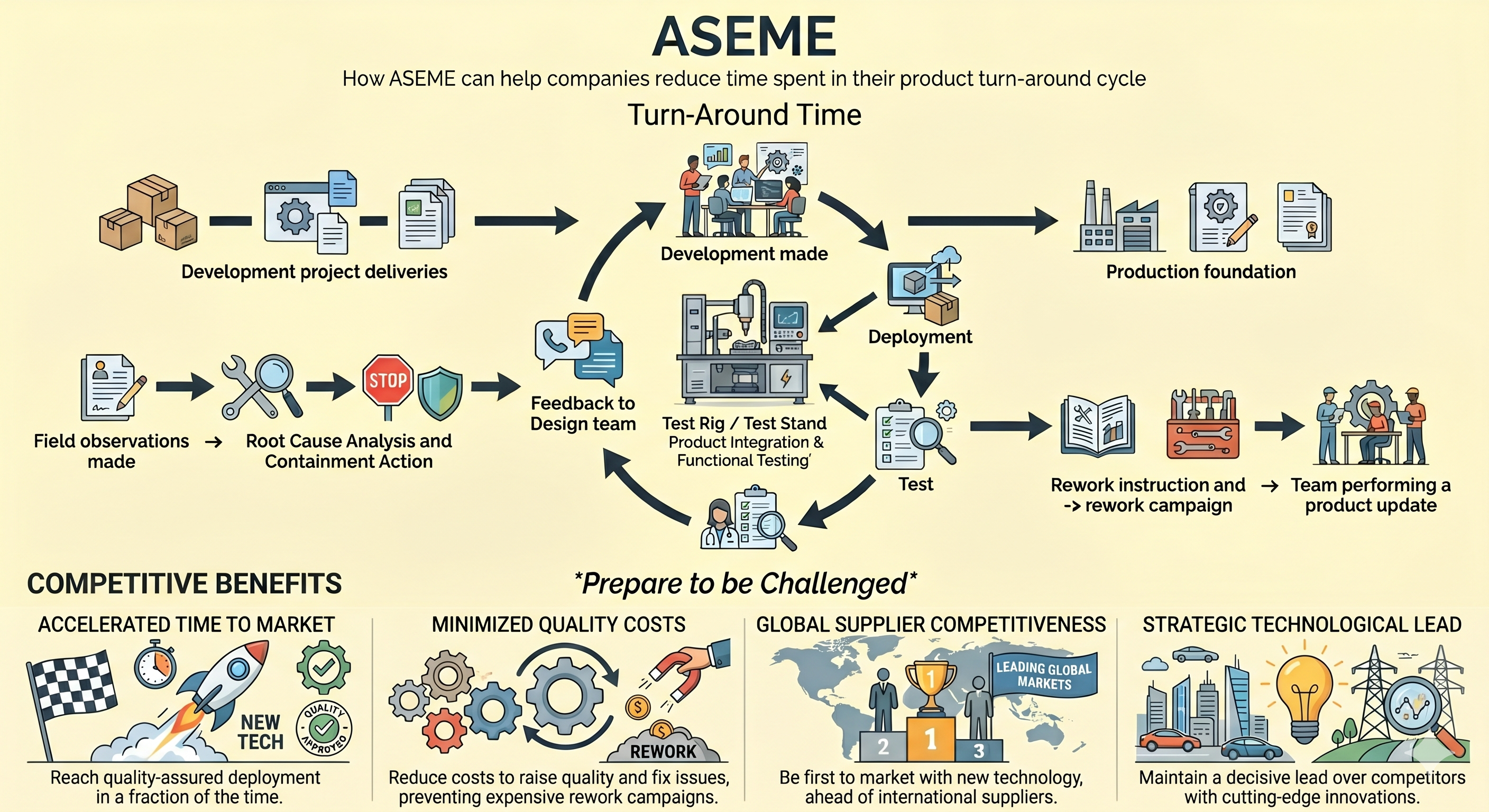
Aggressive turn-around time is not just about saving a project; it is the time measured from development completion to deployment, testing, and feedback. If feedback is negative, it measures how quickly an update can be re-tested and validated.
ASEME helps map your turn-around cycle to avoid pain points in cross-departmental coordination, bug registration, and PLM changes. Reducing this cycle directly impacts your competitiveness by improving time-to-market and lowering the cost of field reworks.
The goal of an integration plan is to avoid "Big Bang" integration, where failure detection becomes nearly impossible and costs skyrocket. By mapping the product from the final deployment backward through modules, components, and software, you identify where tests are most cost-effective.
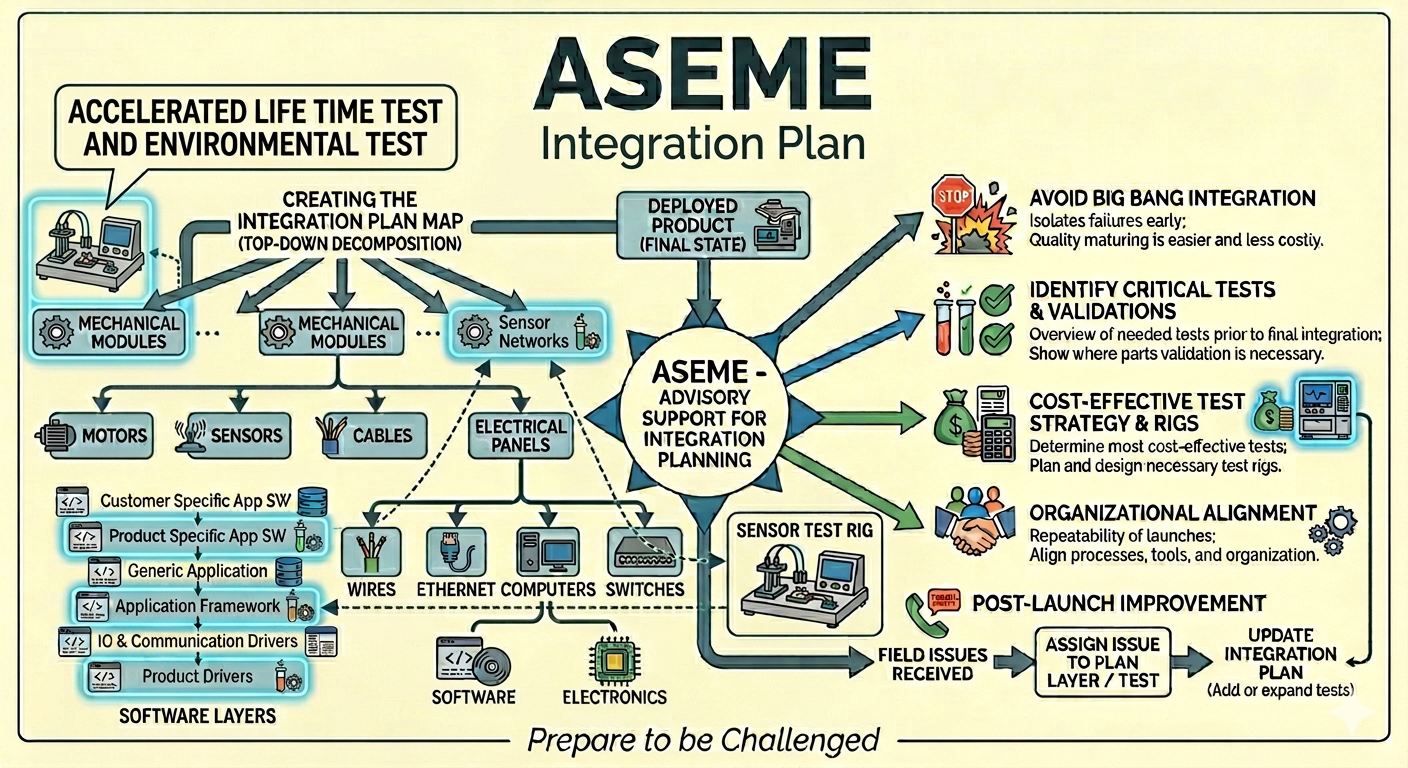
ASEME assists in creating multi-layered integration plans—from unit testing and hardware-in-the-loop (HiL) to complex software regression testing frameworks, all to ensure the most cost effective and quality ensuring product validation.
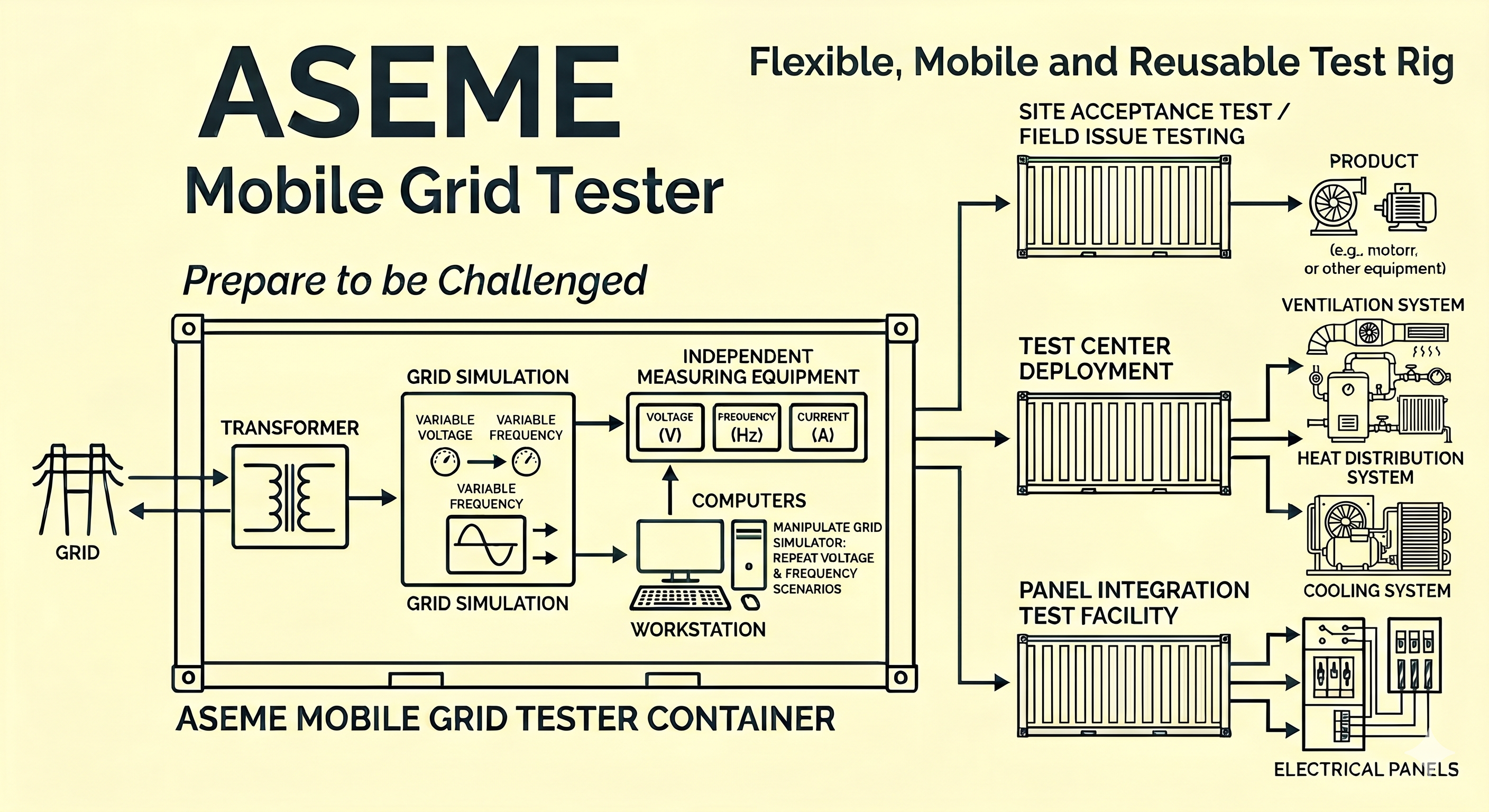
We assist in creating specialized test rigs at critical integration points. Examples include Grid Integration rigs for grid compliance or resilience to voltage anomalies, Motor Load rigs with simulated fluid viscosity changes to test pump performance, and Standards Compliance rigs for EU/UL marking automation.
Example: Flexible and Mobile Grid Tester
For expensive or remote products (like satellites or offshore rigs), an integration test stand is essential. It must contain released product hardware and software, where environmental influences are simulated through models and input is transferred through simulated sensors to the integration test stands sensor input channels. Integration test stands enable:
Functional testing ensures product functions work as intended across the entire product architecture—from sensors and application software to actuators. Functional testing is primarily done at a product integration test stand, and will uncover issues early and ensure high quality at product launch. ASEME can help map out the needed degree of functional testing and help create plans and cost effective test stands to enable the right level of functional testing.
Test stands are extremely valuable beyond design testing. They provide a vital space for support engineers to support field technicians to replicate issues in real-time. ASEME helps operate these stands and trains support colleagues to facilitate efficient Root Cause Analysis (RCA) and 2nd Lind Support with a final handover to your quality and support organization.
Accelerated life time testing repeats specific conditions (like temperature cycles) thousands of times over a short period to project product durability. ASEME helps specify, find test vendors or build test stands to carry out Accelerated Life Time Testing. Performance testing validates that the product or components perform as required. ASEME can help specify performance tests, find a test vendor or build a performance test stand.
In software-heavy environments, regression testing ensures that new updates don't have unwanted side effects. However low coverage ensures that little is tested versus over-coverage will ensure that reguession testing becomes a bottle neck. ASEME helps you strike the balance between broad test coverage and reasonable execution time to avoid "false maturity" quality levels and clogging up the delivery train.
Component testing involves "testing until failure" and testing against relevant standards. We facilitate various environmental tests, including but not limited to:
Factory Acceptance (FAT): Ensuring compliance on produced samples before they leave the manufacturing site.
Site Acceptance (SAT): Validating performance on-site, often in the presence of the customer or a certifying body. ASEME ensures these critical milestones are executed smoothly with the right level of specification, test time and reporting and a few dry-runs.